
Social media ban and new online safety measures
What parents and professionals need to know
The Government has announced a package of online safety measures that go well beyond a social media ban. Here’s what we know, what’s still to be confirmed and what families can do in the meantime.
What we know so far
Latest update
The Government has announced further online safety measures for 16- and 17-year-olds. Social media apps would switch on an overnight curfew from midnight to 6am by default. Features designed to keep people scrolling, including autoplay and feeds that continually serve personalised content, would also be turned off by default.
Older teenagers would be able to change these settings themselves. The measures are not yet in force and are expected to take effect in spring 2027, subject to regulations being approved.
Previously announced measures
The Government’s proposals follow the Growing Up Online consultation, where parents, children and experts shared their views on the opportunities and challenges of growing up online. The new measures aim to strengthen protections for children across the digital services they use.
Watch: What has the Government announced?
What’s included in the new online safety measures
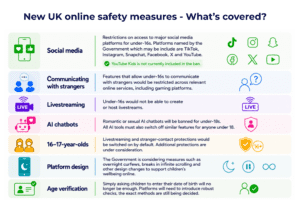
Social media ban
Restrictions on access to major social media platforms for under-16s. Platforms named by the Government which may be include are TikTok, Instagram, Snapchat, Facebook, X and YouTube.
Communicating with strangers
Features that allow under-16s to communicate with strangers would be restricted across relevant online services, including gaming platforms.
Creating livestreams
Under-16s would not be able to create or host livestreams.
AI chatbot
Romantic or sexual AI chatbots and similar features would be restricted for under-18s. The Government also plans to introduce regular breaks for children using chatbots and is considering further action against services that provide dangerous, misleading or unverified mental health advice.
16 to 17 year olds
Livestreaming and stranger-contact protections would be switched on by default. Social media apps would switch on an overnight curfew from midnight to 6am by default. Autoplay and feeds that continually serve personalised content would also be turned off by default. Teenagers could choose to change these settings.
Platform design
Alongside existing protections, platforms would be required to switch off certain features that can encourage prolonged use for 16- and 17-year-olds. This includes videos playing automatically and feeds continually recommending personalised content.
Age verification
Simply asking children to enter their date of birth will no longer be enough. Platforms will need to introduce robust checks, the exact methods are still being decided.
The Government says legislation is expected to be introduced to Parliament before Christmas 2026. If approved, the new rules are expected to come into force in Spring 2027. This means families are unlikely to see immediate changes, but further announcements and details are expected over the coming months.
Although much of the attention has focused on social media, the Government’s proposals cover a wider range of online experiences. This includes preventing under-16s from communicating with strangers through gaming platforms, blocking the creation of livestreaming features and introducing stronger protections around AI services designed for social interaction. The Government has also said that online platforms should take greater responsibility for protecting children. This includes making services safer by design and ensuring age protections work effectively.
The Government’s plans do not stop when a child turns 16. Protections around livestreaming and contact from strangers would be switched on by default for 16- and 17-year-olds. The Government has now also announced plans for social media apps to switch on an overnight curfew from midnight to 6am by default for this age group. Features that can encourage prolonged use, including autoplay and feeds that continually serve personalised content, would also be turned off by default. Unlike the social media restrictions for under-16s, older teenagers would still be able to change these settings. The Government says this approach is intended to provide additional protection while recognising the growing independence of older teenagers. These changes are not yet in force. The first regulations are expected to be introduced before the end of 2026, with the measures expected to take effect in spring 2027.
What we still don’t know
The Government has promised to share more details in July, including what additional protections might look like for older teenagers. We’ll be updating this page as soon as we know more. Here’s what we’re waiting to find out:
Ofcom, the online safety regulator, is looking into the best ways to verify whether someone is over 16, but no final approach has been confirmed yet.
Fines will be aimed at platforms rather than children or parents, but the details of how Ofcom will oversee this hasn’t been set out yet. The Prime Minister has also acknowledged that some teenagers will try to find workarounds like VPNs, and it remains unclear how platforms will be expected to respond when this happens.
The Government has named platforms including TikTok, Instagram, YouTube, Snapchat, Facebook and X as being in scope, but the final list has not been confirmed. It is also still unclear how gaming platforms, livestreaming services and other online spaces will be treated, and how platforms may respond before the rules come into force.
If a child already has an account, it’s not yet clear how that will be handled when the ban comes into force.
The Government has confirmed default overnight curfews, autoplay restrictions and AI chatbot breaks for 16 and 17-year-olds (see above). What’s still unclear is how effectively this will work in practice, since teenagers will be able to switch these settings off, and full detail on enforcement hasn’t been published yet.
While the overall measures have been announced, it is not yet clear which services will be covered, how teenagers will be notified about the settings or how easily they will be able to change them. The full list of features that platforms must switch off has also not been confirmed.
What this means for families today
The details of the Government’s plans may change as more information becomes available. However, the most effective support for children remains the same until any changes actually come into effect.
Whether your child uses social media now or is likely to in the future, this is a good moment to:
- Talk to them about their online experiences, what they enjoy, what they’ve seen and how it makes them feel
- Review the safety settings available on the apps and devices they’re already using
- Help them build the skills they need to navigate online spaces confidently and safely
- If you have an older teenager, talk about whether they would keep an overnight curfew switched on and agree boundaries around late-night use. Default settings can help, but they are not a replacement for conversations, routines and healthy digital habits.
It’s also worth remembering that online safety is about more than social media. Children spend time across gaming platforms, messaging apps, video-sharing sites, livestreaming platforms and AI-powered services- many of which won’t be covered by the ban.
Keeping those conversations open, across all the places children go online, is one of the most effective things a parent or professional can do.
If your child has additional needs, social media and online communities may play a particularly important role in their social life. Visit our additional needs advice hub for tailored guidance.
Talking to children about the announced changes
Children and young people may have different reactions to the announcement.
Some may think it’s a good thing. Some may not be interested. Others may feel confused, worried or frustrated. Teenagers may have strong opinions about what the proposals could mean for them and their friends. The best place to start is by listening and acknowledging their perspective.
Ask children what they have heard and what they think. Try not to assume they feel the same way you do.
For younger children, this may be an opportunity to talk about what they enjoy doing online and who they would speak to if something worried them.
For older children and teenagers, it can open up conversations about the role social media plays in their lives, including both the benefits and the challenges.
The aim is not to have all the answers. It is to create a safe space where children feel comfortable sharing their experiences.
- Have you heard anyone talking about social media?
- What do you enjoy doing online?
- What makes an online experience feel safe?
- Who would you talk to if something worried you online?
- What have you heard about the proposed changes?
- What do you enjoy about social media?
- What don’t you enjoy?
- What pressures do young people face online?
- What would make social media safer for children and teenagers?
Children often respond better when learning happens alongside a trusted adult.
You could explore Digital Matters together, review privacy settings as a family or talk about how recommendations and algorithms work.
These shared experiences can make online safety conversations feel more natural and less like a lecture.
You could try:
- Watching a video together and pausing to chat about what you’ve seen.
- Going through privacy settings side by side on the apps your child already uses. It’s a great way to open up conversation without it feeling like an inspection.
- Trying Digital Matters together – this is our interactive online safety platform, designed for children aged 9–11, which uses stories and activities to explore real online situations. Parents can access it without registering, and it’s a good way to learn alongside your child rather than at them.
Where should parents start?
This moment may prompt families to ask some important questions, like:
- Is my child ready for social media?
- How much do I know about the apps they use?
- Are safety settings switched on?
- How do their online experiences affect their wellbeing?
- What conversations should we be having as a family?
The answers will look different for every family. But staying involved in your child’s digital life and keeping conversations open can make a real difference.
Helpful resources
This can be a valuable opportunity to start conversations about privacy, online friendships, digital wellbeing and how to get help if something goes wrong online.
Related resources
Use this time to understand the platforms they use, review privacy settings and talk about both the benefits and challenges of social media. Our guide What parents can do now to support children online walks through the practical steps families can take today.
Other resources to explore:
Older teenagers will still benefit from support and guidance as they navigate online relationships, misinformation, scams and digital wellbeing.
Related resources
Messaging apps like WhatsApp and Discord are not currently covered by the ban, so it’s worth making sure children are using them safely now. This includes reviewing who can contact them, how group chats are managed and what to do if something feels wrong.
Related resources
Livestreaming will be restricted for under-16s under the new proposals, but many children are already using platforms like Twitch, YouTube Live and TikTok Live. Understanding the risks – and the safety settings available, can help keep them safer in the meantime.
Related resources
AI chatbots are increasingly part of children’s everyday lives — for homework help, entertainment and even companionship. The Government’s proposals include new restrictions on romantic AI chatbots for under-18s, but all AI tools carry risks worth understanding now.
Related resources
What schools and professionals need to know
The announcement will raise questions for teachers, school leaders, social workers and other professionals working with children and young people. This section sets out what the proposals mean in practice and what you can do now to support the children and families you work with.
What does this mean for schools?
The proposed measures are aimed at platforms and regulated by Ofcom; they do not place new legal duties on schools directly. However, schools play an important role in helping children develop the digital skills and resilience they need to navigate online spaces safely.
The Government has also announced changes to media literacy education. From September 2026, RSHE lessons are expected to help children think critically about AI and chatbots, recognise mis- and disinformation and understand how online content can present a distorted view of the world. Wider media literacy changes are planned across the National Curriculum from September 2028.
The announcement is also a prompt to review how online safety is currently embedded in your curriculum, pastoral care and communications with parents.
What can schools and professionals do now?
There are practical steps you can take today, ahead of any legislation coming into force:
- Talk to children and young people about the announcement in an age-appropriate way. Use it as an opportunity to explore their experiences of social media, gaming and online communication, not as a warning, but as an open conversation
- Signpost parents and carers to trusted resources. Many families will have questions following the announcement and will look to schools and professionals for guidance. Sharing this page is a good starting point
- Review your online safety curriculum to ensure it covers the full range of digital experiences children have, including gaming, messaging, livestreaming and AI, not just social media
- Consider the needs of vulnerable children in your setting, including those with SEND or additional support needs, for whom social media and online communities may play a particularly important role
Some children may have strong feelings about the proposed ban, particularly older teenagers. Professionals should be prepared for a range of reactions, from relief to frustration, and create space for those conversations without judgment.
Children who rely on online spaces for social connection, including LGBTQ+ young people, those with additional needs or those who are isolated, may need additional support as the landscape changes.
- Digital Matters- free interactive online safety platform for use in schools and with children aged 9–11
- Teacher hub – guidance, lesson plans and resources for educators
- Online safety advice for children with additional needs
- Supporting LGBTQ+ children online
- Government fact sheet for the social media ban
Frequently asked questions
There is currently no requirement for parents to remove social media accounts.
Instead, use this opportunity to understand how your child uses social media, discuss any concerns and review available safety settings.
Related advice: Social media advice hub
Start by asking what they have heard and how they feel.
Reassure them that many details are still being discussed and that any future changes are unlikely to happen immediately.
Most importantly, let them know they can continue talking to you about their online experiences and concerns.
Related advice: Supporting children’s online wellbeing
Yes.
This is a great opportunity to start building the skills children will need later. Conversations about privacy, online friendships, kindness, digital wellbeing and knowing how to ask for help can all begin before social media becomes part of their lives.
Related advice: Online advice by age
Many children worry about missing out if they are not using the same platforms as their friends.
Try to understand what they feel they might miss and discuss the benefits and challenges of social media together.
Focus on your child’s readiness rather than comparing them to others.
Related advice: Is my child ready for social media?
Yes. The Government plans to require social media apps to switch on a midnight-to-6am curfew by default for 16- and 17-year-olds. Autoplay and feeds that continually recommend personalised content would also be turned off by default. Your teenager would be able to change these settings themselves.
Protections around livestreaming and contact from strangers would also be switched on by default. The rules are not yet in force and are expected to take effect in spring 2027.
Related advice: Advice for teens (14+)
The Prime Minister has acknowledged that some teenagers will try to find workarounds, such as using a VPN or accessing platforms through a friend’s account.
The Government has said enforcement will focus on platforms rather than children, so the responsibility for preventing this sits with the tech companies, not with families.
That said, if you are concerned your child might try to bypass restrictions, the most effective thing you can do is keep the conversation open. Children who feel able to talk to a parent about their online lives are far better placed to make safer decisions, with or without a ban in place.
Related advice: Having conversations about online safety
No.
Children may still encounter risks through gaming platforms, messaging apps, video-sharing sites, livestreaming services and other online spaces.
This is why digital skills, critical thinking and ongoing support remain important.
Related advice: Online safety advice hub
Start by reviewing privacy settings, parental controls and account security features together.
Many platforms offer tools that can help families manage who can contact children, what content they see and how much time they spend online.
Related advice: Parental controls hub and platform guides
Messaging services like WhatsApp and Signal have been explicitly excluded from the proposed social media ban. The Government has stated it does not intend private messaging apps to be included.
Discord is less straightforward. Because it combines messaging, gaming and community features, it is not yet clear how it would be treated under the proposals. We will update this page as more details are confirmed.
More broadly, it is also not yet clear how other services such as gaming platforms and livestreaming apps will be treated.
If children are worried about something they have seen or experienced online, encourage them to speak to a trusted adult.
Additional support is available through:
- Childline — free, confidential support for children and young people
Supporting resources
Find more helpful resources to learn more and help keep your child safer online.
Social media advice hub
Government fact sheet on the social media ban
New social media curfews and crackdown on addictive features
Social media to be banned for under-16s – GOV.UK
Advice by age
 Close video
Close video
Close video
Close video
Close video
Close video
Close video
Close video
Close video