Support children’s online activities
Get advice to help children get the most out of their online activities. Whether they’re chatting on social media or online gaming with friends, find ways to help children build their digital literacy skills and stay safe online.

What’s inside this guide
Visit our advice hubs for support on how to make your child’s online activity safe and fun. We’ve included 3 top tips for each type of activity to get you started.
Using artificial intelligence
As artificial intelligence (AI) becomes more widely used, children face risk and opportunity.
Explore how AI tools work, their impacts on children and potential risks. Then, see what you can do to keep your child safe.
The best way to understand a platform’s risks and benefits is to use it. If your child wants to use AI, explore it first to show them appropriate use.
Thinking critically and keeping information private can help your child stay safer with AI. Talking with them regularly can help them learn these skills.
Before letting your child use AI tools, review the Privacy Policy and see what data is collected. Then, turn off data collection if possible.
Social media and chatting online
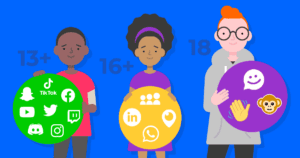
Social media and messaging are a big part of children’s lives.
Help them enjoy it safely with tips on managing accounts and sharing wisely. Discover how tools can make it easier to keep conversations safe.
Go through privacy settings together so they know who can view their posts and send messages. Encourage them to choose friends they know personally.
Remind your child that once something is shared, it can be hard to take back. Talk about the importance of keeping personal information private.
Many platforms offer parental tools. Use them to spot any risks but make it clear that you’ll use these tools to keep them safe, not invade their privacy.
Online gaming
Online gaming opens up worlds of fun but can come with risks.
Learn about tools to manage screen time, control in-game spending, and encourage safe player interactions.
All consoles have built-in parental controls that can help manage manage screentime, game ratings and limit chat functions if necessary.
Reinforce that your child should never share personal info, such as their full name, school or location with other players—even if they seem friendly.
In competitive games, emotions can run high. Discuss how to use in-game options, like blocking and reporting, to deal with rude or aggressive players.
Watching and browsing online
Kids love streaming and exploring online, so it’s essential to keep it age-appropriate.
Learn how to manage access to content, limit screen time, and make smart choices about what they watch, for a safe online experience.
Setting up filters is an effective way to ensure children only access age-appropriate content. Select ones that align with your child’s age and maturity.
Encourage your child to think about why certain content appeals to them, and guide them to pick content that has positive messages or educational value.
Encourage children to take regular breaks, especially if they’re watching for more than an hour, to reduce eye strain and prevent fatigue.
Creating and sharing online
From dance to drawing, kids love sharing their creations.
Support their passions by ensuring they know how to share safely, respect copyright, and use AI tools responsibly to create original content.
Help children find safe spaces to share their work with friends or family. Social media isn’t the only option; child-friendly platforms may be better suited.
Let children know that while it’s okay to be inspired by others, it’s not okay to claim someone else’s work as their own.
For instance, if they’re using AI to help write a story or generate images, encourage them to do the final editing and add their personal touch.
Learning and building skills
Technology can be a great learning tool if used wisely.
Visit the hub to help children find reliable resources, make the most of AI for education, and stay focused on safe learning experiences.
Identify a few reputable educational sites, such as BBC Bitesize. Make these accessible by bookmarking them, so children can easily return to them.
Explain to children what makes a resource credible. Discuss how to spot signs of unreliable sites, like exaggerated claims or an excessive number of ads.
Set up a routine where part of their study time is devoted to screen-free activities, such as reading a physical book or solving maths problems on paper.
Spending money
From buying items in-game to online shopping, children spend money in a range of ways.
Explore the hub to help children develop good online money management. You’ll also learn about in-game spending and scams.
Set limits by agreeing on the rules around spending, such as asking for permission. You can make use of built-in parental controls to restrict spending.
Make use of bank accounts and debit cards designed for children. These accounts are a great way to learn the value of money and how to save.
Discuss with your child the reasons behind their purchases to help them understand the value of virtual items in real terms.