
Help your child use social media safely before the ban
The UK government announced a social media ban for under-16s along with restrictions on other features. While we wait for more detail and action, the need to support children on social media can’t wait. Here’s what you can do right now.
On this page
- Why social media is still a challenge for families
- What the consultation means for families
- Social media features every parents should know about
- Supporting their wellbeing
- Supporting resources
Why social media is still a challenge for families
Social media is part of most children’s lives. It’s where friendships form, interests are explored, and communities are found. For many young people, it’s a genuinely positive space.
But it’s also designed to keep people engaged. Features like disappearing messages, algorithm-driven feeds, and streaks aren’t accidents; they’re intentional and shape children’s experiences in ways that aren’t always visible to parents.
The Online Safety Act has raised the bar for platforms, and more change may be coming. But what you do at home still makes one of the biggest differences.
What the consultation means for families
The government’s ‘Growing Up in the Online World’ consultation closed in May 2026, gathering views from children, parents and carers on issues including social media age limits, addictive design features and parental controls.
A response is expected in summer 2026, with possible measures including a minimum age for social media access, restrictions on features like infinite scrolling and autoplay, and simpler parental controls across platforms. Until those changes come into effect, the most reliable protection is still you.
Social media features every parent should know about
These features shape what children see, how long they stay online, and what risks they’re exposed to. Download the full guide for platform-specific steps, or use the summaries below to get started.
Trying to manage every feature or every app can feel overwhelming. Instead, focus on the areas most likely to affect children’s safety, well-being, and everyday experiences online.
These include:
- Private messaging and group chats
- Algorithm-driven feeds and recommendations
- Notifications, streaks and endless scrolling
- Likes, followers and social pressure
- Location sharing and live streaming
- Disappearing messages and hidden interactions
Many of these features are designed to keep users engaged for longer, so children often need support to recognise how platforms influence what they see, how they feel and how long they stay online.
Parental controls and safety settings can help, but ongoing conversations are just as important.
Children are more likely to come to parents for help if they feel supported rather than monitored. Regular, calm conversations can also help children build confidence and resilience online.
You don’t need to have one “big talk”. Short check-ins often work better.
Try questions like:
- “What’s showing up on your feed lately?”
- “Do you feel comfortable in your group chats?”
- “Have you ever seen something online that upset or worried you?”
- “Do you think social media affects your mood?”
- “What do you enjoy most about the apps you use?”
These conversations can help parents spot concerns early while also understanding the positive role social media may play in a child’s life.
Many social media feeds are powered by algorithms that learn from every scroll, click, pause and interaction. This means children can quickly be shown more extreme, upsetting or unhealthy content without actively searching for it.
Parents can help children take more control over what they see by:
- Using “Not interested” tools
- Resetting or refreshing feeds
- Clearing watch and search history
- Encouraging children to unfollow accounts that negatively affect their mood
- Reviewing feeds together to spot patterns
It can also help to remind children that what they see online is not always balanced, realistic or representative of real life.
Follower counts, likes, and views can shape how children feel about themselves online.
For some young people, social media can create pressure to look a certain way, always be available or compare themselves to others.
Parents can support healthier habits by:
- Encouraging children to create, not just consume
- Turning off visible likes where possible
- Keeping accounts private
- Reviewing followers and online interactions together
- Talking openly about edited content, filters and unrealistic expectations
Helping children focus on how content makes them feel – rather than how popular it appears – can reduce some of the pressure linked to social validation online.
Many apps use notifications, autoplay, streaks and endless scrolling to encourage children to keep returning.
Rather than focusing only on total screen time, it can help to look at how and when children are using devices.
Simple steps include:
- Turning off non-essential notifications
- Using focus or “Do Not Disturb” modes
- Agreeing on device-free times as a family
- Keeping devices out of bedrooms overnight, where possible
- Using built-in screen time dashboards together
The goal is not necessarily to remove social media entirely, but to help children build healthy routines and better awareness of their own habits.
Many safety settings are not turned on automatically, and platforms update features regularly.
Parents should regularly review:
- Who can contact their child
- Who can view posts or stories
- Location sharing permissions
- Group chat settings
- Live streaming permissions
- Disappearing messages and auto-delete settings
Using a child’s real age on accounts is important because many platforms apply additional protections to under-18s automatically.
Features like disappearing messages, screenshots, live streams and private chats can sometimes create a false sense of privacy.
Children may need reminders that content shared online can still be copied, saved or shared with others.
Encourage children to pause before posting or sending something by asking:
- “Would you still feel okay if someone else saw this later?”
- “Would you say this face-to-face?”
- “What information does this post reveal about you?”
Building these habits early can help children make safer decisions independently over time.
Even with safety tools in place, children may still encounter upsetting experiences online.
Warning signs might include:
- Sudden changes in mood after using devices
- Becoming secretive about online activity
- Withdrawing from friends or activities
- Difficulty sleeping
- Anxiety linked to notifications or messages
If something does happen:
- Stay calm and avoid blaming the child
- Listen first before reacting
- Save evidence where needed
- Use blocking and reporting tools
- Seek extra support if needed
Children are far more likely to ask for help again if they feel supported rather than judged.
Supporting their wellbeing
Social media isn’t all risk, but there are signs it may be affecting your child: becoming withdrawn or anxious after being on their phone, seeming preoccupied with likes or appearance, losing interest in things they used to enjoy, or struggling to sleep.
If you notice these signs, start a conversation rather than reaching straight for restrictions. Children who feel able to talk to a parent about what happens online are far better placed to handle difficult situations when they arise. You don’t need to be a social media expert; you just need to ask and to listen without jumping to solutions.
Building healthier habits together, phone-free mealtimes, no devices before bed, talking about the difference between enjoyable use and mindless scrolling, tends to work better in the long run than outright bans.
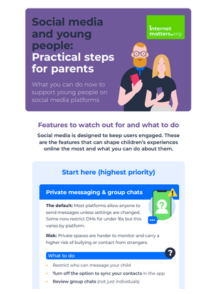
Read the infographic

Supporting resources
Explore the research further or find helpful resources that can help keep your child safer online.

Social media parental controls
Is your child ready for social media?
Guide to having conversations

Advice by age
 Close video
Close video
Close video
Close video
Close video
Close video
Close video