
July 25th marks one year since the implementation of Ofcom’s Protection of Children Codes, a key set of measures under the Online Safety Act aimed at keeping children safe online. A year on, have children’s online lives gotten safer?
Summary
- Children continue to face widespread online harm, with 52% of children experiencing at least one type of harm the Online Safety Act aims to address
- More action is needed to keep children safe including stronger age assurance, action on addictive design and protections when using AI chatbots.
- Future policy should build on – not replace – the Online Safety Act. Even with the announcement of a social media ban for under-16s, the Protection of Children Codes remain essential for keeping 16- and 17-year-olds safe and children safe on other services such as messaging and gaming platforms.
Introduction
Under the UK Online Safety Act (henceforth the OSA), the Protection of Children Codes (the PoC Codes) require online services to identify and reduce the risks platforms pose to children. They aim to make online spaces safer by ensuring platforms take responsibility for protecting young users from harmful content and experiences.
Since implementation in July 2025, there has been some evidence of positive change to children’s online lives, which we explore in our report assessing the efficacy of the Online Safety Act. However, our evidence also shows gaps and challenges. Children continue to encounter harm on the platforms and services they use, and navigate challenges such as addictive design and emerging technology.
At the same time, children’s online safety has stayed firmly in the public eye which has led Government to announce plans to ban social media companies from offering their services to under-16s. While these proposals have attracted significant attention, the OSA remains a landmark piece of legislation that will play a critical role regardless of any future age-based restrictions.
Drawing primarily on insights from Internet Matters Pulse, this blog explores what has changed for children in the year since the PoC Codes came into force.
Internet Matters Pulse
Internet Matters Pulse is a bi-annual, nationally-representative survey of 1,000 UK children aged 9-17 and 2,000 UK parents of children aged 3-17. The latest survey was conducted in April – May 2026. It asks children and parents a range of questions about children's digital habits, online experiences, parents' concerns and approaches to online safety.
Children have experienced positives changes to their online lives
Children report some positive changes to their online experiences since the PoC Codes came into force.
Our report The Online Safety Act: Are children safer online? found that around seven in ten (68% of) children report seeing more safety measures such as improved reporting tools, content filters and blocks on certain functions such as live-streaming.
Children continue to experience harm online
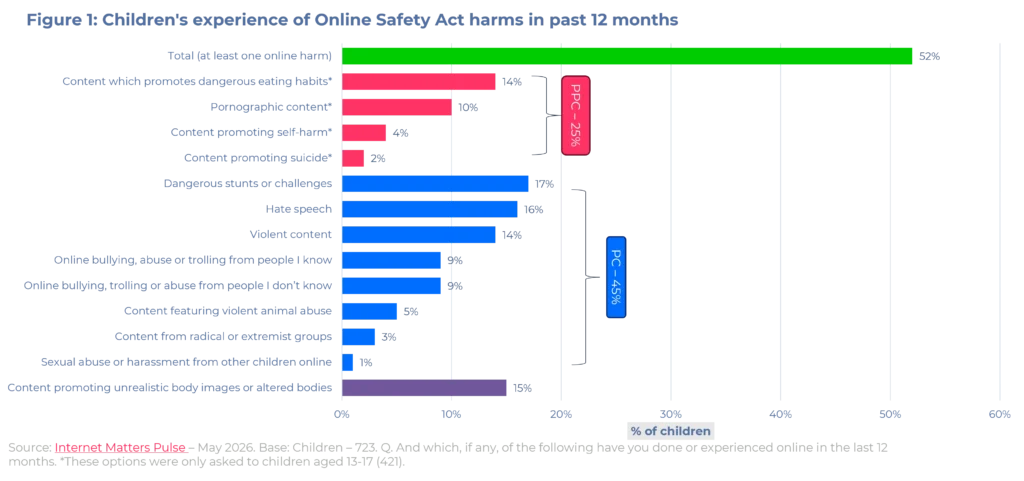
Despite positive changes, children continue to experience harm online. Internet Matters Pulse finds that, in the past 12 months, half (52%) of children experienced at least one type of online harm the OSA aims to tackle. This includes 25% of children reporting harm that can be categorised as primary priority content, such as pornographic content or self-harm content and a further 45% of children told us they came across priority content harms such as violent content or hate speech.
The ‘Online Safety Act’ harms
Internet Matters Pulse collects data on a wide-range of online harms that may be experienced by children, including exposure to mis- and disinformation, online scams and spending too much time online. For the purposes of this blog, we reflect on online harms specifically designated under the OSA. Here is a breakdown:

Online harm is experienced across multiple platforms
Children experience online harm across a range of platforms. In the past 12 months, 85% of the online harms categorised under the OSA and reported by children occurred on social media platforms, making social media the most common location of harm. However, this should be understood in the context of children’s online activity. Social media is where children spend the most time online, meaning it is unsurprising that a large proportion of harm is experienced in these spaces.
Beyond social media, 22% of online harms were experienced on gaming platforms and 20% on messaging services.

For vulnerable children, who often experience the best and worst of online life, these figures are even more pronounced. We refer to children with special educational needs (SEN), have an Education, Health and Care Plan (EHCP) and/or who have a physical or mental disability requiring professional health as ‘vulnerable’.
Compared with children without these vulnerabilities, vulnerable children are twice as likely to experience online harm on gaming platforms (36% cf. 18%) and are also more likely to experience harm on messaging services (29% cf. 17%).
Critical gaps remain in protecting children online
While the Online Safety Act marks an important step forward for children’s online safety, significant gaps remain. Future policy developments, including a social media ban for under-16s, must consider how best to respond to these gaps.
Effective age assurance remains critical
Age assurance is a critical layer to keeping children safe online. If services cannot or do not accurately identify the age of a user, they will not be able to enforce age restrictions or apply age-appropriate safeguards.
The continued presence of under-13s on services where they are not permitted shows that existing systems are not always effective. For instance, 33% of 9-12-year-olds use TikTok, 23% use Instagram, and 24% use Snapchat, platforms that have a minimum age of 13.
To be effective, age assurance must deliver its intended outcomes: preventing children from accessing age-restricted platforms and services while enabling age-appropriate experiences. It should be applied consistently across both new and existing accounts, be privacy-preserving by design, and provide accessible and inclusive methods for young people to verify their age.
Children’s struggles with screen time remain unaddressed
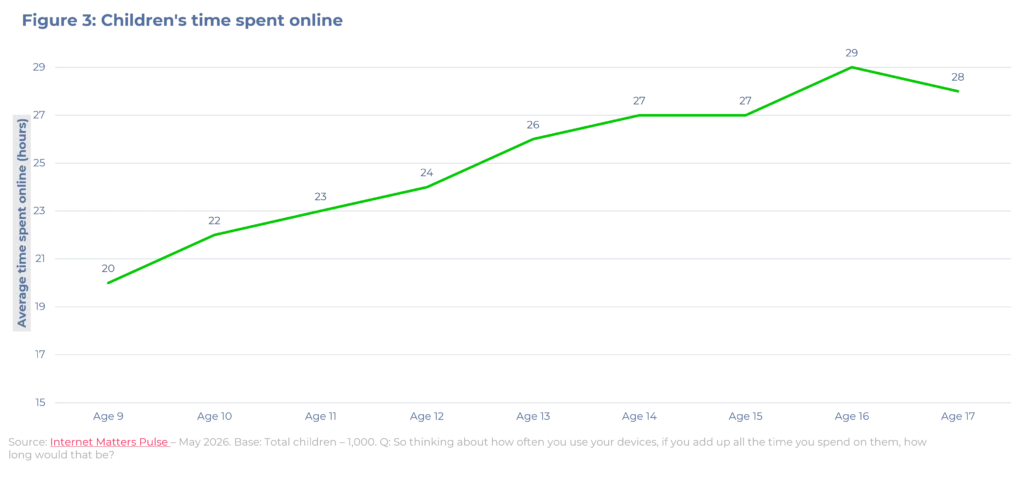
Our research shows that many children struggle to manage the amount of time they spend online. Internet Matters Pulse finds that children are spending over a day online a week, at 25 hours on average with time spent online peaking at 29 hours a week at age 16. Two-fifths (39%) of children tell us that they feel like they spend too much time online and three-quarters (73%) of parents are concerned about this.
Despite this, the OSA does little to tackle problems of excessive screen time or the addictive design features that can encourage prolonged engagement. And while the social media ban aims to prevent children under-16 accessing spaces with these features, it does not address addictive design features (e.g. infinite scroll, autoplay, push notifications) that will continue to persist – including in spaces not impacted by a ban.
Ultimately, without stronger measures to address this, children will continue to face challenges of prolonged screen use and addictive design.
AI chatbots are continuing to evolve
Emerging technology, such as artificial intelligence, continue to rapidly evolve and present a new set of challenges for online safety regulation. AI chatbot use is growing among children, with 71% of children now saying they have used an AI chatbot compared to 64% a year ago.
While some AI chatbots are subject to elements of the OSA, current regulation is insufficient to address the range of risks these chatbots pose which go beyond harmful content, such as over-reliance, emotional dependency and addiction. Recently announced measures to help children use AI chatbots safely, such as regular breaks for under-18s, may promote healthier engagement but they do not directly address the design of technology itself or the breadth of risks it presents. As a result, this leaves the burden of managing risks on families.
The future of the Online Safety Act
Significant public attention on children’s online safety has culminated in the Government’s announcement to ban social media platforms from offering their services to under-16s. While such restrictions are intended to reduce children’s exposure to harmful content and contact, and limit time spent on high-risk platforms, this alone will not improve children’s safety and wellbeing.
This is why the Online Safety Act and the Protection of Children Codes remain critical, providing a framework for platforms to design safer services and reduce harms across the broad range of spaces children use, including gaming and messaging services. It will also be crucial to keeping children safe in the interim before a ban comes into force in 2027.
One year on from the implementation of the Protection of Children Codes, significant challenges remain. However, the OSA remains just as important. Continued monitoring, robust enforcement and ongoing refinement will be essential if it is to fulfil its ambition of making the online world safer for children.