
Generative AI is changing the way children learn, play and grow in a digital world. But it is also increasingly clear that not all children have the same opportunities, knowledge and confidence to harness these tools safely and critically.
Drawing on new data taken from our Me, Myself and AI report, this blog explores how household income shapes families engagement with AI and what further support is needed.
Summary
- AI is already a growing part of childhood
- Parents awareness of and engagement with AI is closely linked to household income, shaping the support children receive at home
- Children from lower income households are less likely to discuss AI at school, reflecting wider inequalities in media literacy education
Most children are already engaging with AI
Internets Matters’ report Me, Myself and AI found that two-thirds of children aged 9-17 (64%) had used an AI chatbot. This figure has since grown, with 71% of children in our recent Internet Matters Pulse survey (May 2026) now reporting using at least one type of AI chatbot.
Children use AI chatbots in diverse ways, from learning and schoolwork to play, advice-seeking and even companionship. But our research also found that engagement with AI chatbots carries real risks, including exposure to harmful or age-inappropriate content, inaccurate responses, and emotional over-reliance.
Children themselves recognise the need for better guidance. In our focus groups, they expressed a desire for teachers to support their use of AI in school while also raising concerns about inaccuracy, privacy and over-reliance. Reflecting this growing role of AI in education, the UK Government has begun encouraging the use of AI tutoring tools in the classroom, particularly emphasising their potential to provide safe, personalised support for disadvantaged pupils.
Against this backdrop of increasing adoption and policy direction, it is more important than ever that all children, regardless of background, have the knowledge, tools and safeguards they need to navigate AI safely and confidently.
Knowledge and awareness of AI increases with household income
Parents and carers are children’s main source of information about online safety. Given this, their awareness and use of emerging technologies like AI directly shapes how well they can support their children to use them safely.
As seen in Figure 1 below, knowledge and awareness steadily increases alongside household income.
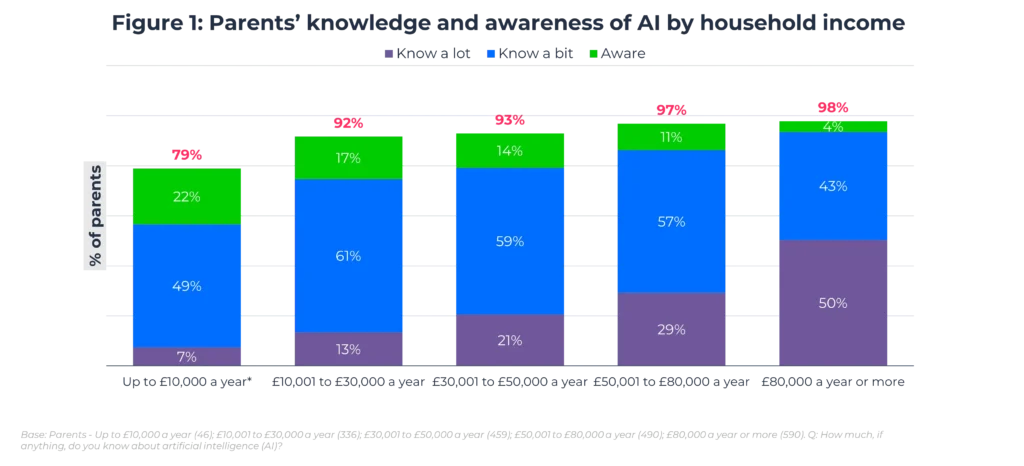
Our data reveals a stark knowledge gap between parents of higher income and lower income families. While 98% of parents in households earning £80,000 or more report they are aware or knowledgeable about AI, this drops to 79% among those earning up to £10,000 a year.
This divide is sharper when looking at those who report knowing a lot about AI – 7% of parents from the lowest income bracket compared to 50% in the highest.
This is also reflected in the use of AI. For instance, just a quarter (28%) of parents in low income households have used ChatGPT compared to 76% of parents in households in the highest income bracket.
Those from lower income households are less likely to know if their child has used chatbots
This income gap in parents’ knowledge and awareness of AI extends to parents’ knowledge of their child’s use of AI chatbots. A third (34%) of parents from lower income households are not sure whether their child has used a chatbot, compared to 12% of parents from the highest income households.
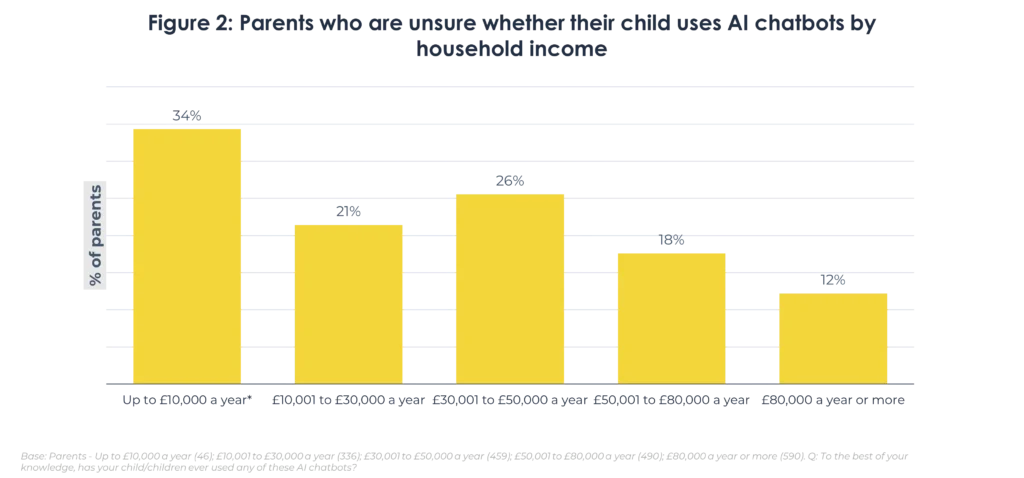
This low of awareness of their child’s use, combined with being less likely to engage with AI themselves, leaves parents from lower income households less equipped to support their child when using AI chatbots. Without this awareness, important conversations about using AI safely, critically and responsibly are less likely to happen.
Household income impacts conversations about AI
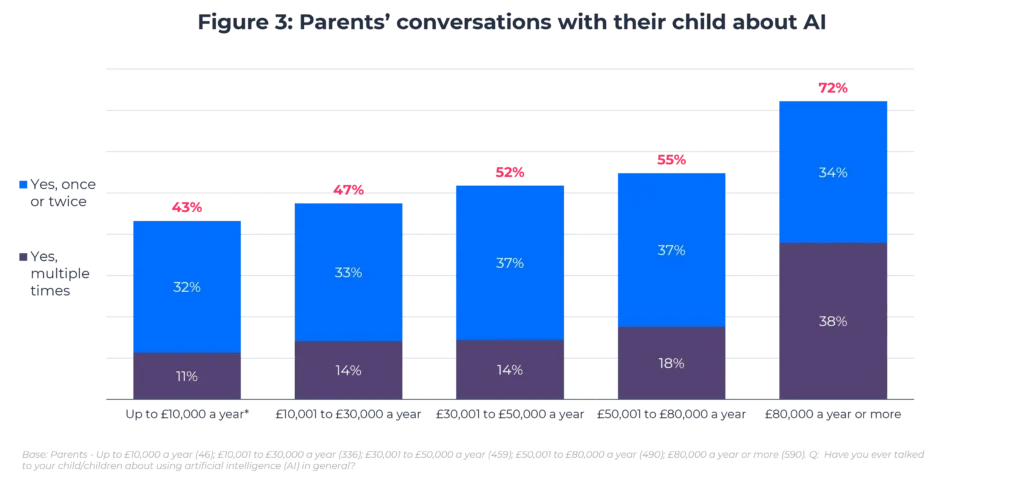
Given these gaps, it is perhaps unsurprising that higher income households are having more conversations about AI. Three-quarters of parents from the highest income brackets (72%) have spoken to their child about AI, compared to less than half (43%) of parents from the lowest income households.
Parents from lower income households are also less likely to have multiple of these conversations, with 38% of those in households earning £80,000 or more discussing AI with their child on multiple occasions compared to just 11% of those earning up to £10,000 a year.
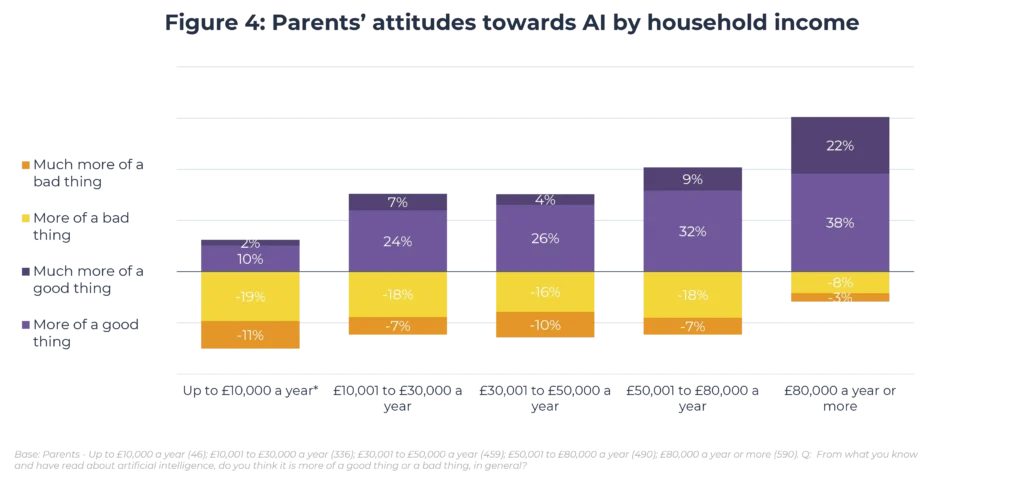
When these conversations do happen, there are some clear differences in what is discussed which is likely related to broader attitudes towards AI. Parents from higher income households are far more likely to see AI as a good thing (60% of those earning £80,000 or more compared to just 12% of those earning up to £10,000 a year). This positivity appears to shape what they talk about, with higher income households more likely to discuss what AI can do (56% cf. 39%) and what AI is (40% cf. 26%).
Children from lower income households are less likely to discuss AI at school
Schools play an essential role in building children’s understanding of AI as well as broader media literacy skills and knowledge, especially where opportunities to build knowledge and confidence may be varied at home. Yet, our Me, Myself and AI report revealed that there are socioeconomic disparities in AI literacy education. Nearly two-thirds (64%) of children from households earning above £50,001 have spoken to their school or teachers about AI, compared to 48% of those from households earning between £10,000-£50,000 a year. This data suggests that children with less support at home are also not being supported in schools.
These findings support our previous work which show media literacy education is a postcode lottery.
What needs to be done
From parental awareness and attitudes to conversations at home and school, children’s experiences of AI are being shaped by household income. Those from lower income households are less likely to have an informed parent to guide them or to be equipped with the knowledge and confidence to use these tools safely and critically.
For parents and carers, building awareness of AI and its implications is an important first step in supporting their children. But this is not just a challenge for families to navigate alone: closing this gap is a shared responsibility to ensure that every child, regardless of background, has the support they need to engage with AI confidently.
For schools, we welcome the Government’s commitment to embed media and digital literacy in the school curriculum in England through expansion in the Computing and Citizenship curriculums. To ensure that these changes are effectively implemented, we urge Government to support schools and teachers with clear guidance, resources and teacher training.
For support in the meantime, parents and teachers can explore our free online platform Digital Matters, which includes interactive lessons and activities on AI and online safety.
Supporting resources

Me, Myself and AI research
A parent's guide to AI

Digital Matters: The tool takeover

Government commits to improving media literacy education in England
 Close video
Close video
Close video
Close video
Close video
Close video
Close video