
What do young people like about social media?
Like other online spaces, young people face risks while using social media. That doesn’t always mean harm though.
For many young people, social media is a place to connect, learn and develop. See how you can help them do so safely.

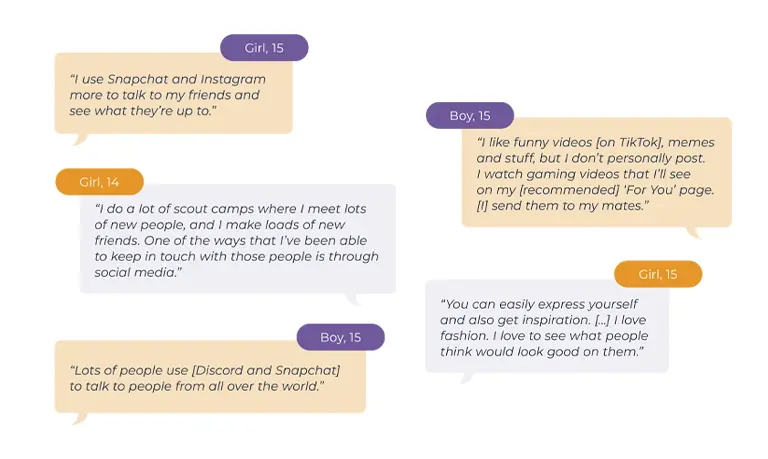
Why young people like social media
Although social media can present some risks of harm, many young people also see the benefits. Explore their thoughts on social media below.
Research from the UK government found that 82% of young people aged 10-21 said that social media helps them feel connected to others. What ‘connection’ means will vary between children but can include:
- Staying in contact with friends and family;
- Finding communities of people with similar interests;
- Getting advice from content creators who have similar backgrounds;
- Finding unique content from new creators which help young people to feel less alone.
It’s not necessarily always about communication but knowing that there are others like them out there. This can feel really important in adolescence when young people are figuring out who they are and potentially feeling like an outcast.
Older teens especially see social media as a way to learn about the world. Whether that’s through talking to someone on the other side of the world, watching diverse content or simply following news accounts, they feel more informed.
For some teens, staying informed can help them feel more confident in their knowledge about current events and politics.
A number of teens also say that social media helps to support their academics. This might look like following content creators which help them study or which help break down topics. There are also ‘study with me’ livestreams to encourage revision and accountability.
And because social media can feel more anonymous, they might be more willing to ask questions they might be embarrassed to ask about a topic in class.
Because there is a a huge range of content online, social media can also expose young people to different careers and hobbies than they might have seen in their immediate community. Plenty of online tutorials also exist to help young people improve their skills.
Through engaging in online spaces, young people are learning in real time how to navigate new information. Whether that’s seeing AI-generated content, assessing whether comments can be trusted or knowing how to report harm, social media can allow them to develop their media literacy.
Alongside guidance from trusted adults and regular conversations about the online world, social media can help young people become savvy digital navigators.
Learning about people from all over the world can help develop young people’s empathy towards others. This can include people from other cultures as well as those with disabilities or different ways of thinking.
Social media can also support children who might find socialising and belonging offline more difficult.
What research tells us
Our research shows that teens see many benefits alongside the risks online. They are aware that social media isn’t perfect, but they also know that they can find enjoyment.
Social media activities
Social media has evolved to include a range of activities from browsing to live streaming. Even playing games with others on platforms like Roblox can be considered a form of social media.
When it comes to social media activities, children aged 13-17 are most likely to:
- Use messaging apps like WhatsApp or Snapchat. This includes using one-to-one messages, group chats or wider communities.
- Browse social media, including searching for content or scrolling through a social feed.
- Watch live streamed content on platforms like Twitch, TikTok and YouTube.
- Play online games with others.
- Post on social media, including videos, images or comments.
For each of these activities, discussing safety with your child and working together to update safety settings can help their experiences remain positive. Explore these step-by-step guides for help on how to do this.
Top 5 tips for keeping teens safe on social media
Here are some ways that you can encourage young people to use social media so it has a positive impact on their wellbeing.
TikTok, Instagram and Snapchat all have versions of parent accounts to support your teen. With these accounts, you can set limits or gain insight into your child’s social media use. Use this to start important conversations with them about healthy use.
Work with your child to discover the tools they can use to keep their social media experiences positive. Tools could include:
- Blocking and reporting within the app;
- Screen time settings in the app;
- Screen time settings across their whole device;
- Settings to curate their algorithm;
- Muting or restricting accounts;
- Adding hidden words or content types to prevent them seeing certain content.
And, of course, they can always come to you for support.
When scrolling through social media, encourage your child to remain active and engaged. They can do this by:
- Telling the algorithm when they don’t like content. They can usually tap 3 dots on a post and choose an option like ‘I don’t want to see this’ or ‘Not interested’ to teach the algorithm.
- Reporting any content that seems harmful towards them or others. They should get into the habit of doing this even if they don’t think anything will come of it.
- Exploring settings and adding ‘hidden words’ or certain content types to the content they don’t want to see. This can help them feel more positive about their time on social media.
- Setting timers to keep scroll sessions to a minimum. This might look like setting a timer on their device, using built-in screen time tools or setting an external timer out of reach, which forces their attention away.
Regular conversations about your concerns can help you feel more confident in your child. Talk about things you hear about in the news, ask their opinions on what you see. Ask them about the things you’re worried about and what they see.
The more you check-in and chat, the easier and more normal these conversations become. And that means your child is more likely to rely on you if they need more support.
Role model the behaviour you’d like them to express on their social media. This might include sharing very little or keeping profiles private.
It could also include how long you spend on social media. Setting screen time limits for yourself in the apps you both use can help them view it as normal.
More in the hub

Supporting resources
Explore our guides to help your teen experience more benefits and less harm on social media.

Step-by-step parental control guides

Social media safety steps for parents
3 boundaries for social media
Social media supervision tools
 Close video
Close video
Close video
Close video
Close video
Close video
Close video