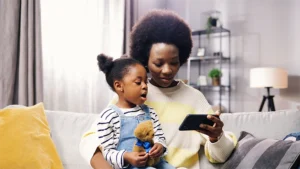

Streaming services, mobile games, social media, work tasks — adults engage with technology in a range of ways that can influence children’s relationship with their devices. Often, you can use the same tips for managing your child’s screen time to help manage your own. Digital Wellbeing on Android devices and Screen Time on iOS are good places to start.
In this article, experts share how your screen time can directly impact your child and their screen time. See how your habits can support your child’s relationship with tech.
Summary
- Your screen time distractions can lead to lost moments of connection. >
- Children learn by watching you, including how you deal with boredom. >
- Types of screen time can matter, but how available you are is more important. >
- Become intentional with your screen time to help you develop positive habits. >
- Create daily boundaries around screen time that the whole family follows. >
- You’re not alone. There are steps you can take to control your screen time. >
- Set screen time limits for yourself using our range of screen time resources. >
How can parents’ screen time distractions impact their children?

Building strong bonds with our babies and children happens naturally as we respond to them with attention and care, moment by moment. When we are preoccupied with our phones and devices, those moments of connection are lost – and this has far more impact than we realise.
This came home to me when I realised my very young daughter was playing with something in the bottom of the bath – that turned out to be my phone! There was a lesson learnt there on the preoccupation with devices, and what happens if they are always too close by.
Understanding ‘mattering’
“Mattering” is a useful way to understand why our screen distraction can have a negative impact on our parenting. According to The Harvard Centre on the Developing Child, mattering refers to a child’s felt sense that they are valued, noticed and emotionally significant to the people who care for them. This sense begins forming when we are babies through everyday, responsive interactions.
When we respond to a baby’s cues, mirror their expressions and comfort them when distressed, the baby receives a powerful message: “You matter!” However, when our attention is repeatedly pulled away by screens, even unintentionally, babies may experience small but cumulative moments of emotional unavailability.
In the short term, being drawn away by our devices may mean babies experience reduced eye contact, facial mirroring and vocal turn-taking. They can also show increased fussiness or withdrawal during interactions, and receive fewer language cues, which are critical for early brain development.
In the long term, repeated disruptions and loss of connection can affect attachment security, particularly in the first two years of life when the brain is developing rapidly. It can also impact language development, emotional regulation, social skills and a child’s developing sense of being emotionally safe.
The Harvard Centre on the Developing Child also highlights that responsive “serve and return” interactions (like following your baby’s cues) are foundational to healthy brain architecture, and that chronic disruptions can weaken this process.

When a parent is often absorbed by a screen, children can experience it as ‘you’re here, but not present’. Research from the University of Essex shows that this can increase frustration, attention-seeking and conflict in the moment.
Over time, frequent interruptions can reduce the quality and quantity of back and forth talk and shared attention. These are key building blocks for early language and relationship development.
How could parents’ screen time habits influence children’s habits?
Children learn through modelling, long before they understand social norms and expectations, and babies are highly attuned to where a caregiver’s attention goes.
When children grow up seeing adults frequently on their phones, screens are normalised as the default response to boredom, stress or social interaction. Boundaries around screen use can feel confusing or unfair if they are not mirrored by adults. And older children may be less responsive to restrictions that feel inconsistent or imposed rather than shared.
Research from the Royal College of Paediatrics and Child Health emphasises that family screen habits, rather than screen time alone, are key to children’s outcomes. When parents demonstrate mindful, intentional screen use, children are more likely to accept guidance and limits as they grow.
Children learn screen habits by watching adults: if phones, for example, are the default for boredom, stress or in between moments, children are more likely to seek screens in the same way.
Restrictions land better when they feel fair. If adults are always on their devices while children’s use is limited, you’ll often see more pushback and boundary testing.
Parental controls help, but they work best alongside a family screen plan where adults model the behaviour too (e.g., phones off the table, especially during mealtimes; devices charging outside bedrooms). This, however, can be tricky and needs to be discussed and agreed as a family.
Does it matter what type of screen time parents are engaging with?
The type of screen use does matter, but from a baby’s perspective, the most important question is whether the parent or caregiver is emotionally available. Using screens for work, caring responsibilities or essential communication is part of life. However, screen use can disrupt connection if it consistently replaces moments of interaction, play or comfort.
Passive or immersive activities like scrolling social media tend to be more disruptive because they are designed to capture and hold attention, and they reduce a parent’s ability to notice and respond to subtle infant cues. Intentional, time-limited screen use, combined with clear reconnection afterwards, is a positive step forward.
At The For Baby’s Sake Trust, tools such as Video Interaction Guidance (VIG) and the Newborn Behavioural Observations (NBO) system are central to helping parents understand just how much babies communicate and how deeply they are affected by adult attention. Both approaches gently slow things down and bring parents’ focus back to the baby, making visible the small but powerful moments of connection that support healthy development.
Through VIG, parents are supported to watch short clips of themselves responding to their baby’s cues, often noticing for the first time how eye contact, tone of voice or a pause to follow the baby’s lead strengthens connection. NBO similarly helps parents tune into their newborn’s signals, capacities and vulnerabilities, reinforcing that babies are active communicators from birth.
In the context of screens, these tools are particularly valuable because they highlight what can be missed when attention is diverted, even briefly, and how meaningful it can be when a parent is emotionally present. Importantly, VIG and NBO are non-judgemental and strengths-based: rather than telling parents what not to do, they build confidence, sensitivity and awareness, helping parents prioritise moments of attuned connection that protect babies’ sense of safety, mattering and emotional wellbeing, even amid the pressures of modern life.
For children, the biggest difference isn’t ‘work vs scrolling’, it’s whether the screen pulls the parent out of the interaction and reduces responsiveness.
Work use can be easier to contain because it’s purposeful and time limited. Social scrolling, on the other hand, is often more open-ended and absorbing, which can create more interruptions.
What matters most is protecting key connection times (i.e., play, meals, bedtime) and making screen use intentional and predictable.
What steps can parents take to improve their own screen habits?
Small, realistic changes are often the most sustainable:
- Choose routine or predictable moments each day (e.g., feeding, bath time, bedtime) where you actively choose to put your phone away.
- Use physical cues: place phones out of reach or face-down during playtime.
- Turn off non-essential notifications, particularly during time with your baby.
- Focus on repair, not perfection: if attention drifts, re-engage with eye contact, touch or voice.
These steps support connection without adding pressure or guilt, which is especially important for parents who are already under strain.
- Start with one protected moment a day (even 10 minutes) where your child gets your full attention. Small, repeatable wins beat big resets.
- Make the habit easier: put your phone out of reach, turn off a couple of notifications and use a short timer for when you want to check your phone.
- Aim for screen-wise, not screen-free. Predictable pockets of full attention matter most (i.e., play, meals, bedtime).
How can parents set boundaries which work for everyone?
Consistency is key, but it doesn’t require rigidity. Parents can:
- Frame boundaries as family values, not just rules for children.
- Be honest about exceptions (like work or personal emergencies). Explain them, share how long it will take and stick to your promises (e.g., I need 5 minutes to focus on this and then I’ll be with you).
- Reflect aloud on your own habits: “I’ve noticed I’m on my phone a lot, so I’m going to put it away now.”
- Invite accountability from other adults in the household.
This approach builds trust and shows children that boundaries are about wellbeing, not control.
- The quickest way to get buy in is to turn child rules into family rules: ‘we’ language, shared routines and shared consequences.
- Pick 1 to 2 boundaries that adults in your home can genuinely keep (e.g., no phones during meals, bedtime or in bedrooms). Consistency matters more than strictness.
- When you slip, repair it out loud: ‘I got distracted; I’m putting it away now’. That’s powerful modelling.
Talk about screen use openly with your child in age-appropriate ways. Simple honesty builds trust; acknowledge that screens can be distracting and that you need to make conscious decisions (e.g. ‘I’m practising putting mine down so we can talk properly’).
Aim for a screen-wise family culture. The goal is a home where screens have a place, but relationships come first and everyone (including adults) practises the same expectations.
What should parents remember about their screen time?
There are a lot of reasons for our unhealthy habits around screen use – there is no judgement here! Apps and platforms are designed to be addictive. Our phone use can also be a response to loneliness, boredom, isolation, work pressures or lack of support.
At The For Baby’s Sake Trust, we work with families where parents are navigating domestic abuse, trauma and other intersecting challenges. In these contexts, screens can sometimes feel like a coping tool or a lifeline.
Conversations about screen time should therefore be trauma-informed, not shaming, and focused on increasing moments of safety and connection rather than achieving perfection (which doesn’t exist!).
For babies and infants, even small increases in warm, responsive interaction can make a meaningful difference to their development and emotional wellbeing.
Shift the focus from minutes to moments that matter. Parents often get stuck counting screen time, but children mainly feel the impact during key connection points (e.g. reunions after nursery/school, play, meals, bedtime, and when they’re upset). Protecting those moments usually makes the biggest difference.
Also, screens aren’t the enemy; stress and exhaustion are. For many parents, scrolling is a quick way to cope. If your phone is your main rest, you don’t need shame, you need better rest and more support around you.